Oversized Packaging Requirements | China to USA | 2026
Blog 2026-07-14
How to Package Oversized Freight for International Shipping — Without Costly Surprises at U.S. Customs
The $15,000 Mistake No Importer Wants to Repeat
An Amazon seller recently learned this lesson the hard way. He went with the cheapest freight quote for a shipment of fitness equipment from China — only to have his entire container rejected at the Port of Los Angeles because the packaging didn’t meet U.S. compliance standards. The result? $15,000 in emergency repackaging fees, delayed pre-orders, and a hit to his seller metrics that took months to recover from.
This is the hidden risk of oversized shipping. Whether you’re importing fitness equipment, furniture, or industrial machinery, improper packaging doesn’t just cost money — it can derail your entire supply chain.
This guide breaks down every packaging requirement you need to know to ship oversized cargo from China to the United States without compliance failures, surprise fees, or delivery rejections.
Why Oversized Cargo Packaging Is Different
Shipping oversized freight from China to the USA isn’t the same as standard parcel shipping. Here’s what makes it unique:
- U.S. Customs enforces strict wood packaging material (WPM) regulations under ISPM 15. Non-compliant wood packaging can result in immediate re-export, fumigation at your expense, or cargo destruction.
- Amazon FBA has specific oversized item requirements — including mandatory palletization, FNSKU labeling, and dimensional weight thresholds that differ from standard-size inventory.
- Freight carriers impose surcharges for non-conforming packaging — from missing hinges ($7.00/crate) to inadequate pallet clearance that blocks forklift operations.
- Insurance coverage depends on proper packaging — most cargo insurance policies won’t pay out if damage results from inadequate crating or palletization.
Understanding these requirements before you ship isn’t optional — it’s the difference between a smooth delivery and a five-figure mistake.
Section 1: Wood Packaging Material Compliance — ISPM 15 & U.S. Customs
ISPM 15 Fumigation Requirements
All solid wood packaging used in international shipping — including wooden crates, pallets, dunnage, and blocking materials — must comply with ISPM 15 (International Standards for Phytosanitary Measures No. 15).
- All solid wood packaging must be heat-treated or fumigated with an approved method (methyl bromide fumigation or heat treatment reaching 56°C core temperature for 30+ minutes).
- A valid fumigation certificate must accompany the shipment. Cargo arriving at U.S. ports without ISPM 15 documentation will be held for mandatory fumigation or re-export — at the shipper’s expense.
- Raw, untreated lumber is strictly prohibited. Only export-grade materials such as plywood, OSB (oriented strand board), or engineered wood products are acceptable for crating.
U.S. Customs Wood Packaging Enforcement
- The ISPM 15 stamp must be visible and legible on all wood packaging components.
- Composite wood products (plywood, particle board, MDF) are exempt from ISPM 15 requirements but must still meet structural integrity standards.
- Repeated violations can result in elevated inspection rates for future shipments, adding days to your customs clearance time.
Section 2: Wooden Crate & Frame Specifications
Minimum Thickness Requirements
| Component | Minimum Thickness | Why It Matters |
|---|---|---|
| Base Plate / Bottom Board | 1.5 cm (0.6 in) | Prevents base sagging or breakthrough under heavy loads |
| Side Panels / Enclosures | 0.8 cm (0.3 in) | Structural integrity with recommended longitudinal reinforcement |
| Internal Bracing / Cleats | 2.0 cm (0.8 in) | Locks the crate body together; critical for load distribution |
| Top Cover / Header Plate | 1.1 cm (0.4 in) | Prevents top-load collapse; upgrade required for ultra-heavy cargo |
| Open Frame Slats | Width ≥ 8 cm (3.1 in), Thickness ≥ 1.5 cm (0.6 in) | Adequate bearing surface and rigidity for open-frame packaging |
| Plywood Panels (General) | 1.2 cm (0.5 in) | Minimum for load-bearing capacity |
| Crate Lids | 1.5 cm (0.6 in) | Thicker than side panels to resist stacking pressure |
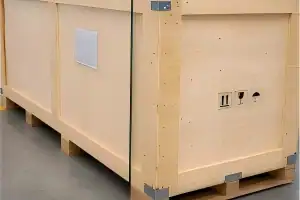
Picture – Wood thickness diagram
Quality Red Lines
The following will cause your shipment to be rejected or incur additional fees:
- ❌ Brittle, cracked, or poorly spliced low-grade wood — structurally compromised and unsafe for ocean transit
- ❌ Yellow packing tape — interferes with warehouse barcode scanning systems used at U.S. fulfillment centers
- ❌ Black stretch wrap on outer packaging — blocks scanning and visual inspection at U.S. receiving docks
- ❌ Nails protruding from crate surfaces — safety hazard that triggers mandatory rework at the warehouse
Crate Opening & Hinge Requirements
All wooden crates must be equipped with hinges and edge-protected corner feet. Crates shipped without hinges will be charged an additional handling fee of $7.00 per piece.
This isn’t an arbitrary fee — hinged crates allow warehouse teams to open and inspect cargo without destroying the packaging, which is essential for customs inspections and FBA receiving processes.
Section 3: Structural Reinforcement Standards
Diagonal Bracing & Framework
Wooden frames must utilize diagonal bracing for structural stability. The maximum slat spacing is 6 inches (15 cm) — wider gaps compromise the frame’s ability to resist shifting forces during ocean transit.
For crates exceeding 20 inches (50 cm) in width, internal crossbeams and vertical support posts are mandatory, with spacing under 16 inches (40 cm) apart.
Top Load-Bearing Beams
For all open-frame wooden crates, heavy-duty load-bearing support beams must be installed at the top section. Crossbeam spacing must not exceed 20 cm (7.8 inches) to prevent collapse and ensure the crate can support top-loaded weight during vessel stacking.
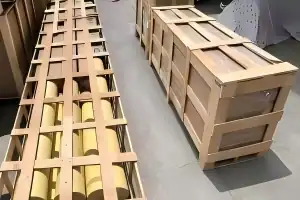
Picture – Top load-bearing beam structure
Horizontal Support for Extra-Long Cargo
For wooden crates longer than 230 cm (90.5 inches) weighing over 500 kg (1,102 lbs), horizontal thin-board support battens must interconnect the forklift skids. This prevents the skids from breaking or collapsing due to inertial forces inside ocean containers.
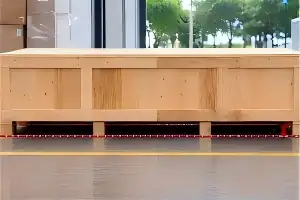
Picture – Horizontal support battens
Irregularly Shaped Cargo Stability
Irregularly shaped items cannot be accepted under standard receiving procedures — they must be repackaged or reinforced to prevent tipping:
| Cargo Height | Minimum Base Width |
|---|---|
| Up to 1.5 m (4.9 ft) | ≥ 50 cm (19.7 in) |
| Over 1.5 m (4.9 ft) | ≥ 70 cm (27.6 in) |
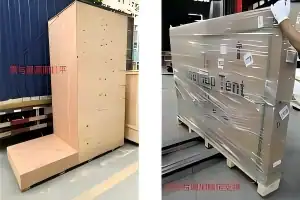
Picture – Irregular cargo base reinforcement
Section 4: Palletization Requirements
Mandatory Palletization Thresholds
Any single package meeting either of these criteria must be palletized:
- Weight over 110 lbs (50 kg), OR
- Any single dimension exceeding 60 inches (150 cm)
The pallet base height must be at least 4 inches (10 cm) to allow standard forklift clearance.
Pallet Design Standards
- 4-way forklift entry is required for all pallets — this ensures seamless loading, unloading, and warehouse handling across U.S. distribution networks.
- Standard U.S. pallet size: 40 × 48 inches (1.0 × 1.2 m) — using non-standard sizes can cause handling issues at U.S. warehouses and FBA centers.
- Packages that are excessively narrow or require vertical orientation must be reinforced with a tripod/stabilizer base to prevent tipping.
Forklift Clearance Specifications
| Cargo Specs | Required Forklift Access |
|---|---|
| Over 40 kg (88 lbs) AND over 1.2 m × 1.0 m (47.2″ × 39.4″) | Forklift skids with heavy-duty hinges, min. 10 cm (4 in) clearance |
| Over 100 kg (220 lbs) AND over 50 cm (19.7″) wide | 4-way forklift access skids, min. 10 cm (4 in) clearance |
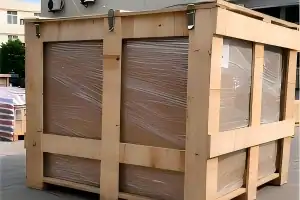
Picture – Forklift clearance diagram
Flight Cases & Rolling Containers
For flight cases or containers with wheels/casters:
- Units under 40 kg (88 lbs) and within 1.2 m × 1.0 m don’t require forklift skids.
- Larger units must have integrated forklift skids with hinges.
- Wheels must be completely suspended off the ground during transit, or the container must be secured to a standard pallet and overwrapped with heavy-duty stretch film.
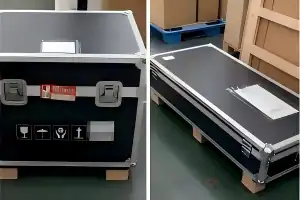
Picture – Flight case on pallet
Section 5: Fragile & High-Value Cargo Protection
Items classified as fragile — including glass, marble, ceramics, display screens, and precision equipment — require a multi-layer protection protocol:
- Internal cushioning — foam, bubble wrap, or custom-fit inserts to absorb shock
- Corner protectors — reinforced cardboard or plastic guards on all eight corners
- Export-grade plywood crating — full enclosure with proper thickness (see Section 2)
- Heavy-duty palletization — secured to pallet with strapping and stretch wrap
- “Fragile” labels — clearly visible on all sides of the crate
- Signed Letter of Indemnity (LOI) — required prior to shipping for all fragile cargo
Section 6: Shipping & Delivery Restrictions
No PO Box or Military Addresses
Shipments cannot be delivered to PO Boxes or military addresses, including:
- APO (Army Post Office)
- FPO (Fleet Post Office)
- DPO (Diplomatic Post Office)
Non-Contiguous U.S. Delivery Restrictions
Delivery services are not available for the following ZIP code prefixes:
| ZIP Prefix | Region |
|---|---|
| 006–009 | Puerto Rico / U.S. Virgin Islands |
| 966–969 | Guam / Northern Mariana Islands |
| 967–968 | Hawaii |
| 995–999 | Alaska |
Section 7: Labeling & Shipping Mark Requirements
All inbound freight must have clearly identifiable shipping marks:
- Recommended: Place orders through the Yunxi system in advance to generate standard barcode labels. Securely attach all labels to the exterior of the outer packaging before warehouse arrival.
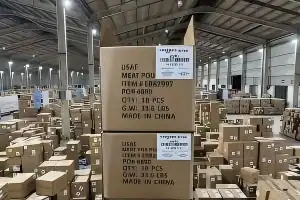
Picture – Barcode label on outer packaging
- Alternative: A highly visible, legible shipping mark must be firmly affixed to the cargo for prompt identification and processing.
- Center of Gravity Labels: If the internal weight distribution is uneven (off-center gravity), prominent forklift placement marks and “Heavy End” indicators must be clearly labeled on the exterior.
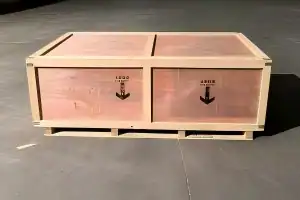
Picture – Heavy end & forklift placement labels
Frequently Asked Questions
What are the ISPM 15 requirements for shipping wooden crates from China to the USA?
ISPM 15 requires all solid wood packaging material (crates, pallets, dunnage, blocking) to be either heat-treated (core temperature of 56°C for 30+ minutes) or fumigated with approved methods. A valid fumigation certificate must accompany the shipment. Non-compliant wood packaging will be held at U.S. ports for mandatory treatment at the shipper’s expense — or re-exported.
When is palletization required for shipping oversized cargo from China?
Palletization is mandatory for any single package weighing over 110 lbs (50 kg) or with any dimension exceeding 60 inches (150 cm). Pallets must have 4-way forklift entry and a base height of at least 4 inches (10 cm) for standard forklift clearance.
What happens if my oversized shipment doesn’t meet U.S. packaging requirements?
Non-compliant shipments face several consequences: cargo holds at U.S. Customs, emergency repackaging fees (often $5,000–$15,000+), delivery rejection by Amazon FBA or your distribution center, and potential cargo insurance claim denials. In severe cases, repeated violations can lead to elevated inspection rates on all future shipments.
How thick does a wooden crate need to be for international ocean freight?
Minimum thickness requirements vary by component: base plates need at least 1.5 cm (0.6 in), side panels 0.8 cm (0.3 in), internal bracing 2.0 cm (0.8 in), and top covers 1.1 cm (0.4 in). For ultra-heavy cargo, thicker panels and additional reinforcing ribs are required.
Can I ship fitness equipment or furniture from China to the USA in cardboard boxes?
Standard cardboard boxes are generally not sufficient for oversized or heavy items like fitness equipment and furniture. These items require export-grade wooden crating or framing with proper palletization to survive ocean transit and meet U.S. warehouse receiving standards. Cardboard-only packaging risks cargo damage, customs holds, and FBA rejection.
What’s the standard pallet size for shipping to U.S. warehouses and Amazon FBA?
The standard U.S. pallet size is 40 × 48 inches (1.0 × 1.2 m). Using this standard size ensures compatibility with forklifts, racking systems, and receiving docks at U.S. warehouses and Amazon fulfillment centers. Non-standard pallet sizes may incur additional handling charges or be rejected entirely.
Ship Oversized Cargo With Confidence
You shouldn’t have to become a packaging compliance expert to import products from China. That’s what we’re here for.
Yunxi Logistics handles every detail of oversized freight packaging — from ISPM 15 certification and export-grade crating to palletization, FBA prep, and U.S. customs compliance. Whether you’re shipping your first container of fitness equipment or managing monthly oversized freight, we turn packaging complexity into a seamless process.
Ship it right the first time. Yunxi has your cargo covered.
Written by the Yunxi Logistics Team — Specialists in safe, compliant, oversized freight shipping from China to the USA.