What Is UN38.3? Lithium Battery Shipping Requirements
Blog 2026-11-05
What is UN38.3? UN38.3 is the part of the United Nations Manual of Tests and Criteria that specifies transport design tests for lithium cells and batteries. If you're importing lithium batteries from China to the United States, ask your supplier for a UN38.3 test summary that matches the battery design you are buying. The summary helps you verify the test record. Your shipment still needs to be reviewed for the correct dangerous goods classification, packaging, transport mode, and carrier requirements.
Your supplier says the battery passed UN38.3. What should you verify before booking freight from China to the U.S.? This guide explains what UN38.3 testing establishes, how to match the test summary to the battery you’ll ship, what paperwork or packaging details can delay booking, and how to arrange testing if your battery design isn’t covered.
Already have a supplier’s battery documents?
Ask for a battery document review on WhatsApp
Start with the battery model, watt-hour rating, and a photo of the battery label.
What Is UN38.3 and What Does It Test?
UN38.3 addresses stresses that lithium cells and batteries may encounter during transport. The applicable tests depend on the design and whether the sample is a cell or a battery. When reviewing a summary, check which tests apply and how the results are recorded.
| Test | What it evaluates |
|---|---|
| T.1 Altitude simulation | Exposure to low pressure |
| T.2 Thermal test | Exposure to extreme temperatures and temperature changes |
| T.3 Vibration | Repeated vibration during transport |
| T.4 Shock | Mechanical shocks during handling and transport |
| T.5 External short circuit | Response to an external short circuit |
| T.6 Impact or crush | Response to mechanical damage to a cell |
| T.7 Overcharge | Response of a rechargeable battery to overcharging |
| T.8 Forced discharge | Response of a cell to forced discharge |
A purchasing team can use the UN38.3 record to verify the design behind a product listing. This matters when a supplier changes the battery pack or offers two capacity options under the same retail product name. Ask for a written link between the SKU you're ordering and the battery design covered by the test record.
UN38.3 test report vs. test summary vs. SDS
| Document | What it tells you | What to check before booking |
|---|---|---|
| UN38.3 test report | Detailed laboratory record for the tested design | Confirm the test report number, battery identifiers, and applicable test results. Yunxi requests the report for its channel review. |
| UN38.3 test summary | Standardized information that lets you trace the battery design to its test record | Match the model, manufacturer, and report number to the goods and supporting documents. |
| SDS or MSDS | Safety information such as hazards, handling, storage, and emergency measures | Check that it covers the same battery and flag any conflicting transport descriptions. |
| Ocean or air transport classification report | How the submitted sample was assessed for the relevant transport mode | Check the mode, validity period, classification, and any stated packing assumptions. |
| Dangerous goods packaging documents | Packaging performance and use evidence, where applicable | Check that the paperwork covers the packaging you intend to use and the way the goods will be packed. |
| Dangerous goods transport declaration (where required) | Shipment-specific declaration prepared for the applicable mode | Confirm the UN number, proper shipping name, package details, and any required signature or permitted electronic authentication against the actual shipment. For air, this may be the Shipper’s Declaration for Dangerous Goods. |
A supplier may send a PDF labeled “UN38.3 certificate.” Open it and identify what it actually contains. If you received only a cover page, request the test summary and the referenced report. An SDS gives your team safety information, while a UN38.3 test summary gives it traceability to the design tests.
What should a UN38.3 test summary include?
A UN38.3 test summary connects a specific lithium cell or battery design to its transport test record. For a U.S. importer, the first check is whether the model, manufacturer, and physical description match the battery being purchased. The summary should identify the testing laboratory, unique report number, report date, applicable tests and results, and a responsible person's name and title. It also records the battery mass and the relevant watt-hour rating or lithium content. PHMSA's July 2024 guidance explains the U.S. summary requirement as revised effective May 10, 2024. Use the summary to trace the tested design, then obtain the referenced full report when requested for freight review. If the supplier changes the pack or component cells, confirm that the record still covers the design being shipped before booking.
Use the summary to answer four questions before paying for freight or scheduling a pickup.
- Who made and tested the battery? Look for the manufacturer and test lab names and contact details.
- Which design was tested? Match the model and physical description. Check mass and, where applicable, the lithium-ion watt-hour rating or lithium-metal content.
- Where is the test record? Look for the unique report identifier, report date, applicable tests and results, and the edition or amendment of the UN Manual used.
- Who is responsible for the summary? Check the name and title of the responsible person. Check for assembled-battery test references where applicable.
If your retail SKU and the battery pack model differ, ask the supplier for a model cross-reference. A product listing or a photo of the retail box rarely tells the freight reviewer which pack design is inside.
How to get UN38.3 testing and documents
Start with the battery manufacturer. If the exact design is already covered, request the test summary and ask for the referenced test report if your forwarder or carrier needs it. If coverage is unclear, have the manufacturer confirm it before relying on the existing documents. For a new design or a change that calls for testing, work with a laboratory that performs UN38.3 tests.
- Confirm the test scope. Tell the lab whether you’re submitting a cell or a battery pack, and describe any differences among model variants. Ask which tests apply, what samples are required, and how to deliver them safely.
- Prepare the submission. Ask the lab for its intake checklist. Typical starting materials include the manufacturer’s details, model and specification sheet, battery chemistry, rated voltage and capacity, Wh rating or lithium content as applicable, and representative samples. The lab may also request label photos, pack configuration, component-cell information, or existing cell test records.
- Obtain and check the documents. After testing, obtain the full report and ask the manufacturer for the corresponding UN38.3 test summary. Check the design identifiers, unique report number, date, applicable tests and results, and responsible person’s name and title before sending the documents for freight review.
Before sending samples: Confirm quantities, lead time, and transport arrangements with the lab. Samples without a verified UN38.3 test record may need special transport arrangements. If cells or the pack design change during production, confirm whether the existing record still covers the new design. Shipment classification, packaging, and carrier acceptance are checked separately.
Does UN38.3 apply to UN3480 and UN3481?
Yes. UN38.3 design testing is relevant to both classifications in ordinary commercial shipments. UN 3480 identifies lithium-ion batteries shipped on their own. UN 3481 covers lithium-ion batteries packed with equipment or contained in equipment. In air transport, those two UN 3481 configurations have separate packing instructions. Tell your forwarder exactly how the batteries will be presented for transport, including any spares.
The watt-hour rating measures stored energy. Output power is measured in watts. The 100 Wh threshold for lithium-ion batteries is one factor in deciding which provisions may apply. Cell-level limits, packing configuration, shipment mode, and other conditions also matter. A rating at or below 100 Wh does not establish eligibility for an exception by itself. For example, the small lithium-ion cell and battery exceptions in 49 CFR § 173.185(c) generally use limits of 20 Wh per cell and 100 Wh per battery, subject to the other applicable conditions.
For the broader route and freight options, see our lithium battery shipping guide for China-to-U.S. imports.
What Yunxi needs before booking a battery shipment from China
For Yunxi's battery shipping channel, prepare the UN38.3 test report and test summary, the SDS or MSDS, and the transport classification report for your proposed mode. If you're comparing ocean and air, send both reports if available. Each report is reviewed against its own mode and the intended shipment.
When the shipment requires dangerous goods packaging documentation and a UN specification box, use a box that meets the applicable requirements and submit the two documents below. Yunxi checks what is required based on the battery rating, transport classification, mode, and packing configuration.
- Packaging performance inspection result. This documents the packaging design's performance inspection.
- Packaging use appraisal result. This addresses how the packaging is used for the dangerous goods being exported.
Send clear photos of the actual UN box and its specification marking for review. Yunxi checks the actual packaging against the documents based on the transport mode and packing configuration. These are Yunxi channel intake requirements. Applicable rules vary with classification and mode, and carrier acceptance is assessed separately.
Battery Shipping Documents and Packaging Examples
Group 1: Battery Test and Transport Documents
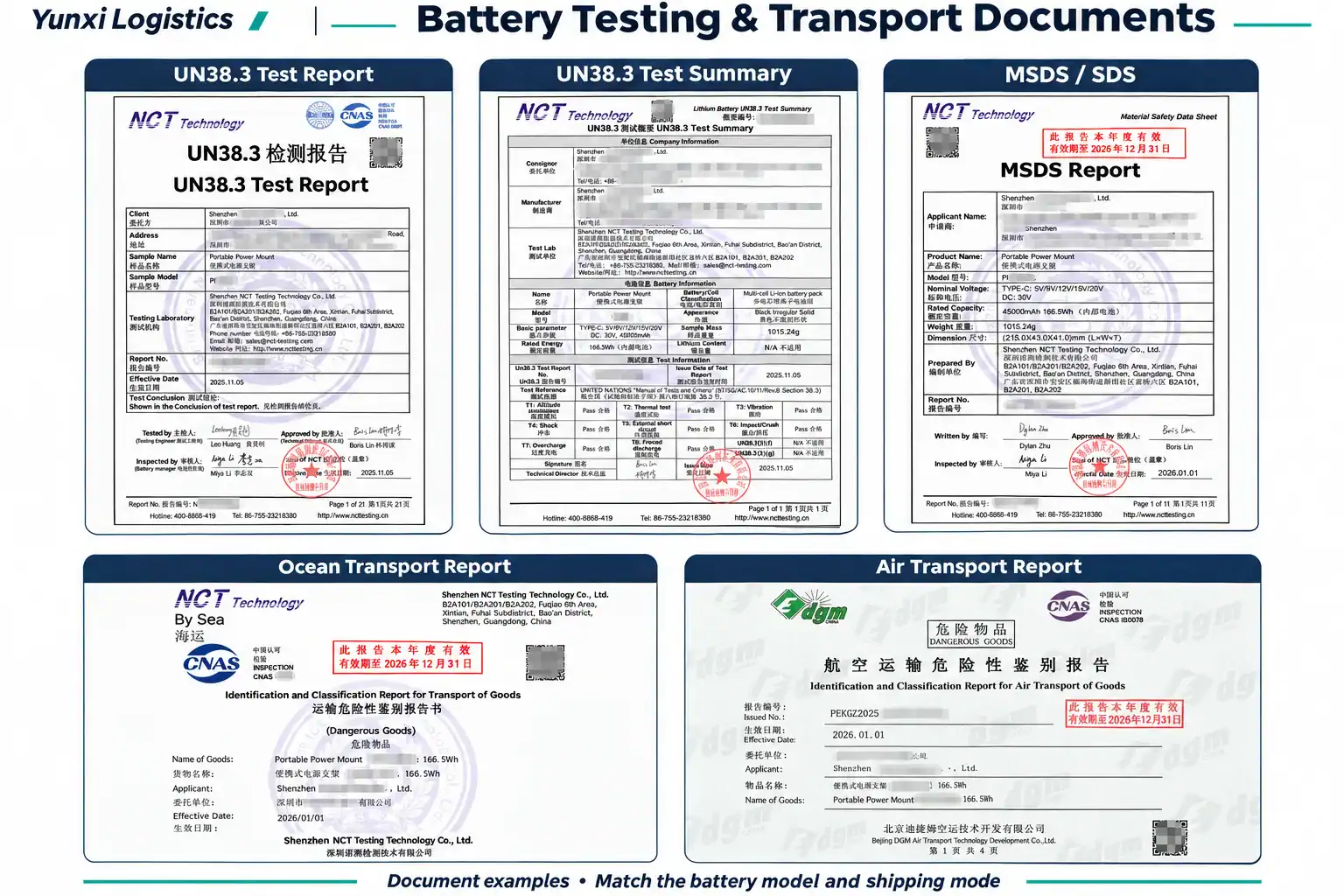 View the battery testing and transport document illustration
Match the test report number in the UN38.3 test summary to the full test report, then check that the battery model and rated energy match the goods being shipped.
The illustration includes a UN38.3 test report, test summary, MSDS/SDS, and ocean and air transport classification reports. Report identifiers have been redacted, so use your supplier’s complete documents to check the report numbers and model details. For the proposed ocean or air shipment, also check the relevant classification report’s transport mode, validity period, and stated shipping conditions.
Group 2: Packaging Documents and UN Box Examples
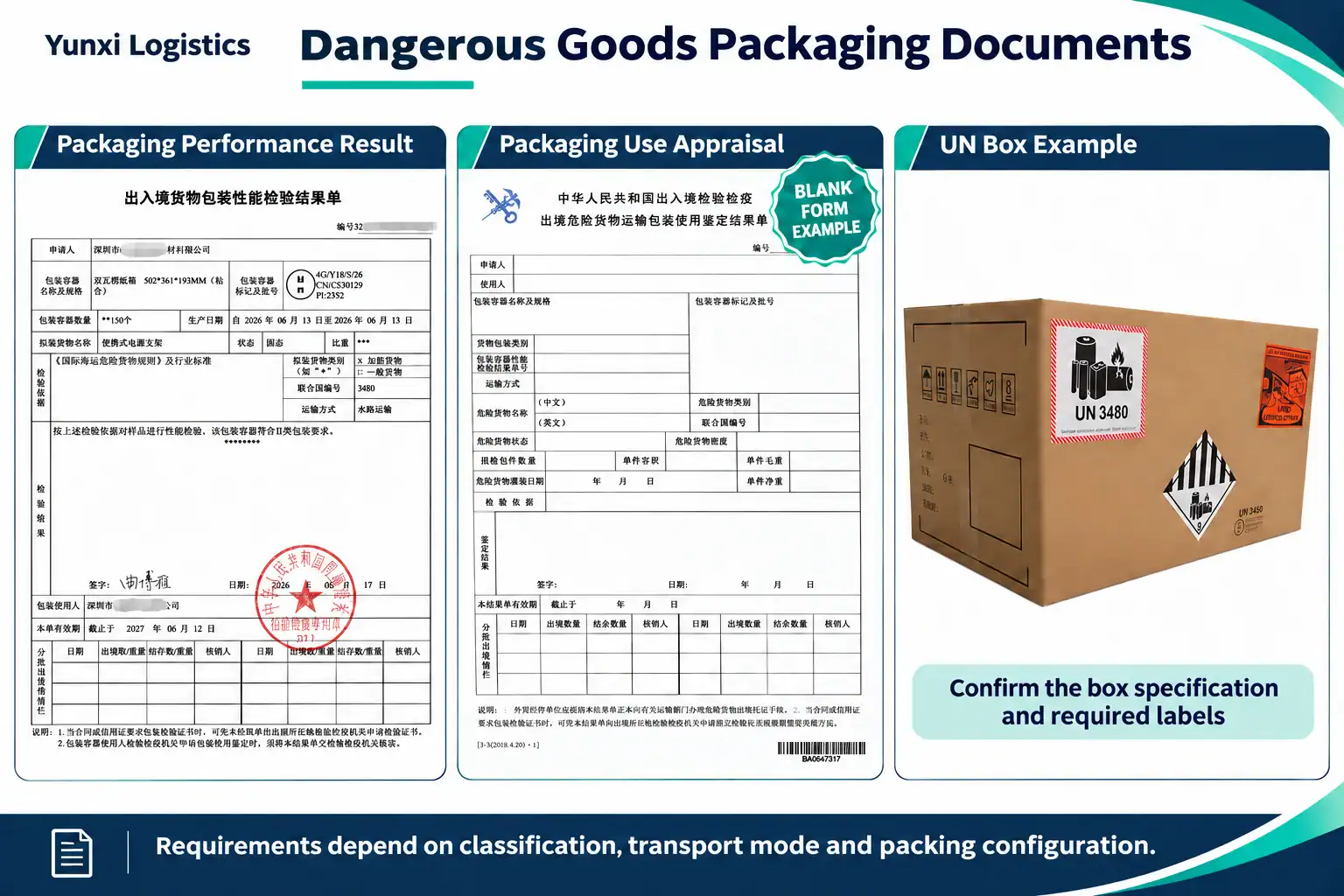 View the packaging document and UN box illustration
Check the performance result for packaging specifications, the use appraisal for the packed goods, and the actual box for the corresponding specification marking and required labels.
The use appraisal shown is a blank form example. For shipment review, provide the completed issued document and clear photos of the packaging you intend to use. Check that the packaging specifications and scope of the documents cover the proposed packing arrangement. Photograph the completed box after taping, wrapping, or palletizing so required marks and labels remain visible. If an overpack obscures them, confirm which must be reproduced outside and whether an OVERPACK marking is required.
Eight checks before booking a lithium battery shipment
| Issue to check | What to verify or request |
|---|---|
| The test summary lists a different battery model | A matching summary or written evidence connecting the shipped model to the tested design |
| The supplier changed cells during production, even though the retail SKU stayed the same | Ask for written confirmation that the current design is covered by the test record. If coverage cannot be established, ask the manufacturer or lab whether further testing or updated documentation is needed. |
| The summary and full report have different reference numbers | The full report cited by the summary, or clarification from the issuer |
| The SDS and classification report disagree on chemistry or shipping description | A corrected document or written clarification tied to the exact sample |
| UN numbers differ across documents | Match each document to the battery and its shipping configuration, then ask the issuer to resolve unexplained differences. |
| Expired transport or packaging documents, or missing sign-off | Check dates for the planned shipment and obtain complete issued versions with applicable signatures, stamps, or electronic authentication. |
| The supplier supplies only a packaging performance result | The packaging use appraisal, actual box photos, and the packing details required for the proposed mode |
| State of charge (SoC) for air freight | The 2026 IATA DGR requires SoC ≤30% for PI 965, PI 966 Section I, and PI 966 Section II cells/batteries above 2.7 Wh, subject to applicable approval provisions. |
A battery shipped alone can have a different UN classification from the same battery installed in equipment. A UN number is not a required field in the U.S. test summary. That summary must identify a responsible person by name and title, while 49 CFR § 173.185(a)(3) does not require a handwritten signature. For the SoC row, see the 2026 IATA guidance, pages 4 and 14.
Check the delivery address before requesting a quote
- Amazon FBA: Before packing, confirm that the battery product is eligible for your destination fulfillment center and shipping program. Check the current U.S. FBA carton-weight limits and apply the required heavy-package handling labels, such as Team Lift or Mechanical Lift, where applicable. Keep handling labels and required battery transport marks visible.
- Residential delivery: Before requesting a rate, confirm whether you need liftgate delivery and who will unload the freight. Tell us if the receiver has a dock, forklift, or other unloading equipment, and whether the handoff is curbside or requires inside delivery. Share any truck access restrictions.
Frequently asked questions
Who should provide the UN38.3 test summary?
Start with the battery or product manufacturer. A distributor or supplier can help you obtain the summary for the exact design. If the product contains a battery from a third party, ask the product supplier to identify that pack so you can verify the right record.
Does the UN38.3 test summary have to travel with every shipment?
U.S. rules generally require manufacturers and subsequent distributors to make the applicable summary available. A freight forwarder or carrier may request it during review. Ask your logistics provider how it wants the documents submitted for your shipment.
Does a UN38.3 report expire every year?
UN38.3 design testing does not have a universal annual renewal requirement. Check that the report still represents the current design and meets the applicable test requirements. Separately check the dates on your air or ocean classification reports and packaging paperwork. A change in battery design, shipping configuration, or applicable rules can require a fresh review.
Can I use the same UN38.3 summary for air and ocean freight?
The summary describes the tested battery design and can support review for either mode when it matches the goods. Air and ocean have their own transport and packing requirements, so the rest of the shipment file should be reviewed for the selected mode.
Can an SDS or MSDS replace UN38.3 documentation?
No. UN38.3 documents identify the tested battery design and record the applicable transport tests and results. An SDS or MSDS describes hazards, safe handling, storage, and emergency measures. Yunxi requires both sets of information for its battery channel review.
What if my supplier sends a CE or EMC certificate?
Keep it with your product compliance records. For the transport review, request the UN38.3 documentation and the applicable shipment documents. A CE or EMC certificate has a different purpose and does not establish the battery's transport test record.
Request a China-to-U.S. battery shipping assessment
Once you have answered “what is UN38.3?”, the next step is checking the documents for your actual shipment. Send the product and battery model, chemistry, Wh rating, label photos, units per carton, packed dimensions and weights, China pickup city, U.S. ZIP code, and cargo-ready date. Tell us whether the batteries ship alone, alongside equipment, or installed. Attach the documents you have and flag any missing items. That gives our team enough information to identify what needs clarification and assess available route options.
If you need China pickup, include the supplier’s collection address and cargo-ready date so we can assess the inland transport arrangements.
Explore Yunxi's battery shipping service or visit Yunxi Logistics for other China-to-U.S. freight services.
References
- PHMSA — Lithium Battery Test Summaries
- 49 CFR § 173.185 — Lithium Cells and Batteries
- IATA — 2026 Battery Guidance Document
- China Customs — Export Dangerous Goods Packaging Use Appraisal
- IMO — International Maritime Dangerous Goods Code
- Amazon Seller Central — U.S. FBA box weight and heavy-package labeling guidance