Battery Shipping from China to USA by Sea: Complete Guide for Amazon Sellers & Importers (2026 Update)
Blog 2026-07-24
Lithium battery shipping is one of the most heavily regulated and risk-prone categories in cross-border ocean freight. For US-based Amazon sellers, importers, and commercial buyers sourcing battery-powered products from China, navigating battery shipping from China to USA correctly can mean the difference between consistent inventory restocks and costly customs seizures, fines, or Amazon FBA rejections. This guide breaks down all the rules, documentation, shipping methods, and delivery options you need to move battery cargo safely, compliantly, and cost-effectively via ocean freight.
1. Why Lithium Battery Sea Freight From China to USA Requires Specialized Dangerous Goods Handling
Lithium-ion batteries are classified as Class 9 hazardous goods under international maritime rules, meaning shipping lithium batteries via ocean freight cannot be handled like standard general cargo. Improper declaration, packaging, or handling poses fire and thermal runaway risks, leading to strict penalties from carriers, customs authorities, and marketplace platforms.
1.1 Class 9 Hazard Classification: Why Lithium Batteries Are Regulated
Under the IMDG Code (International Maritime Dangerous Goods Code), lithium batteries fall under three core UN classifications:
- UN3480: Standalone lithium-ion cells and battery packs (including power banks)
- UN3481: Electronic devices with built-in or packed-with lithium batteries
- UN3171: Battery-powered vehicles such as e-bikes and electric scooters
All three categories require official dangerous goods (DG) declaration, specialized packaging, and approved vessel stowage. Many new importers mistakenly assume small batteries or built-in batteries are exempt from DG rules, but this is the leading cause of cargo detention at US ports. Non-compliant shipments can face fines of up to 4x the cargo value, forced return, or destruction by US CBP.
1.2 Real-World Risks of Non-Compliant Battery Ocean Shipping
Cutting corners on compliance when importing battery products from China leads to predictable, costly consequences:
- Customs detention: Battery cargo is 3–4x more likely to be selected for intensive customs exams, resulting in 1–4 weeks of delays and hundreds to thousands of dollars in port storage fees.
- Carrier penalties: Major ocean carriers impose heavy fines for undeclared DG cargo, and repeat violations can blacklist your shipment from future sailings.
- Amazon FBA rejection: Incorrect labeling or packaging will result in refused deliveries, charged return fees, and potential account penalties.
- Safety hazards: Poorly packed batteries carry thermal runaway and fire risks, endangering the entire vessel and all co-loaded cargo.
2. Critical Regulations & Compliance for Lithium Battery Shipping to USA by Sea
Successful cross-border battery logistics to the US depends on meeting three layers of regulation: Chinese export rules, international maritime standards, and US import & domestic delivery requirements.
2.1 IMDG Code Requirements for Ocean Transport
The IMDG Code sets global standards for dangerous goods sea transport. For lithium batteries, this mandates certified UN packaging, proper hazard labeling, accurate DG declaration, and approved stowage on board. Non-compliant packaging will be rejected by the carrier before loading, even if all other paperwork is complete.
2.2 UN38.3 & Mandatory Product Certifications
All lithium batteries require a valid UN38.3 test report to verify they pass altitude simulation, thermal cycling, vibration, shock, and short-circuit safety tests. This is a non-negotiable requirement for Chinese export DG declaration, and the report must exactly match the battery model and specifications being shipped.
Additional US-market certifications such as CPSC (consumer product safety) and FCC (electronics) are also required for most retail and Amazon FBA products, and are routinely verified during customs inspections. Since 2026, US CBP has significantly increased enforcement of UL certification requirements for lithium battery products.
2.3 USA Battery Import Compliance Rules
On the US side, import compliance covers CBP classification, duty calculation, and product safety verification. Customs clearance for battery cargo requires accurate HTS coding, complete commercial documentation, and valid safety certifications. Missing or invalid certifications are the most common cause of long-term port holds.
2.4 DOT Rules for US Domestic Ground Delivery
For final-mile delivery within the US, lithium battery shipments must also comply with US Department of Transportation (DOT) 49 CFR regulations for ground transport. This applies to both Amazon warehouse deliveries and commercial/residential address drops, and violations can result in fines from federal regulators.
3. Available Ocean Shipping Methods for Batteries From China to USA
When planning sea freight for dangerous goods such as lithium batteries, ocean transport is the most cost-effective and widely available option for all but the most urgent orders. Below are the two primary service models:
3.1 FCL Lithium Battery Shipping (Full Container Load)
FCL DG containers are ideal for high-volume importers shipping 20 CBM or more of battery cargo. You get exclusive use of a dedicated DG container, faster transit times, and lower risk of delays from co-loaded cargo inspections. This is the preferred option for bulk pure battery shipments and large e-bike or energy storage orders.
3.2 LCL Battery Shipping (Less Than Container Load)
For smaller batches (typically 1–20 CBM), LCL battery shipping allows you to share DG container space with other compliant shippers. This dramatically lowers entry costs for small and mid-sized sellers testing new products or placing restock orders.
Yunxi Logistics operates dedicated LCL DG services for battery cargo, with fixed weekly sailings and strict cargo vetting to eliminate co-loading risk from non-compliant goods. All LCL cargo is pre-audited for compliance before being consolidated, so your shipment will not be delayed by another shipper’s violations.
3.3 DDP Door-to-Door Battery Sea Freight
Most Amazon sellers and importers prefer DDP (Delivered Duty Paid) service, which bundles export declaration, ocean freight, customs clearance, duty, and final delivery into one all-in price. Door-to-door shipping eliminates the need to manage multiple vendors and removes surprise destination charges, making budgeting simple and predictable.
4. Last-Mile Delivery Options: Amazon FBA vs Commercial & Residential Addresses
The final leg of shipping lithium batteries via ocean freight is domestic US delivery, and requirements vary dramatically based on your destination type.
4.1 Shipping Batteries to Amazon FBA by Sea
Amazon FBA logistics for battery products has strict inbound requirements that go beyond standard freight rules. To avoid rejection, your shipment must meet Amazon’s hazardous goods packaging, labeling, and documentation standards.
Key requirements include:
- Strict per-box weight and lithium content limits
- Official Class 9 hazard labels and lithium battery marks
- Accurate FBA shipping labels placed in the correct, unobstructed location
- Advance delivery appointment scheduling
Our team handles pre-delivery inspections and priority appointment booking to maximize first-time acceptance rates at all major US FBA warehouses.
4.2 Battery Delivery to Commercial & Residential Addresses
For non-FBA destinations such as retail warehouses, business offices, and residential addresses, delivery requirements focus on DOT ground transport rules and accessorial services.
- Commercial addresses: Standard dock delivery with lower accessorial costs, ideal for wholesale and 3PL warehouse drops.
- Residential addresses: Require additional coordination, liftgate service, and appointment delivery, with corresponding surcharges.
Last-mile delivery is handled via our in-house trucking fleet of 300+ vehicles and trusted partner networks, covering all contiguous US states.
5. Documentation & Packaging Requirements for Battery Ocean Shipping
Proper documentation and packaging are the foundation of compliant cross-border battery logistics to the US. Missing or invalid paperwork is the #1 cause of shipment delays and detentions.
5.1 Complete Document Checklist
To ship batteries via ocean freight, you will need:
- MSDS/SDS (Safety Data Sheet) with correct transport information in Section 14
- Valid UN38.3 test report matching your exact battery model and specifications
- Dangerous Goods Packaging Certificate (required for batteries over 100Wh)
- Commercial invoice and detailed packing list
- Product certification documents (CPSC, FCC, UL as applicable)
Our compliance team conducts a full pre-shipment document review to catch errors before your cargo leaves China, reducing avoidable inspection risk.
5.2 Packaging Standards for Battery Cargo
All battery shipments must use certified UN 4G fiberboard boxes with official permanent UN marking codes (handwritten or sticker marks are invalid). Internal packaging requires individual battery insulation, anti-static bags, and void fill to prevent movement during transit.
Outer cartons must display three mandatory labels:
- Class 9 diamond hazard label
- Lithium battery mark with UN number and 24-hour emergency contact
- “This Side Up” handling arrows
We provide full packaging guidelines and in-house repacking services at our China warehouses to ensure full IMDG compliance.
6. Category-Specific Lithium Battery Sea Freight Solutions
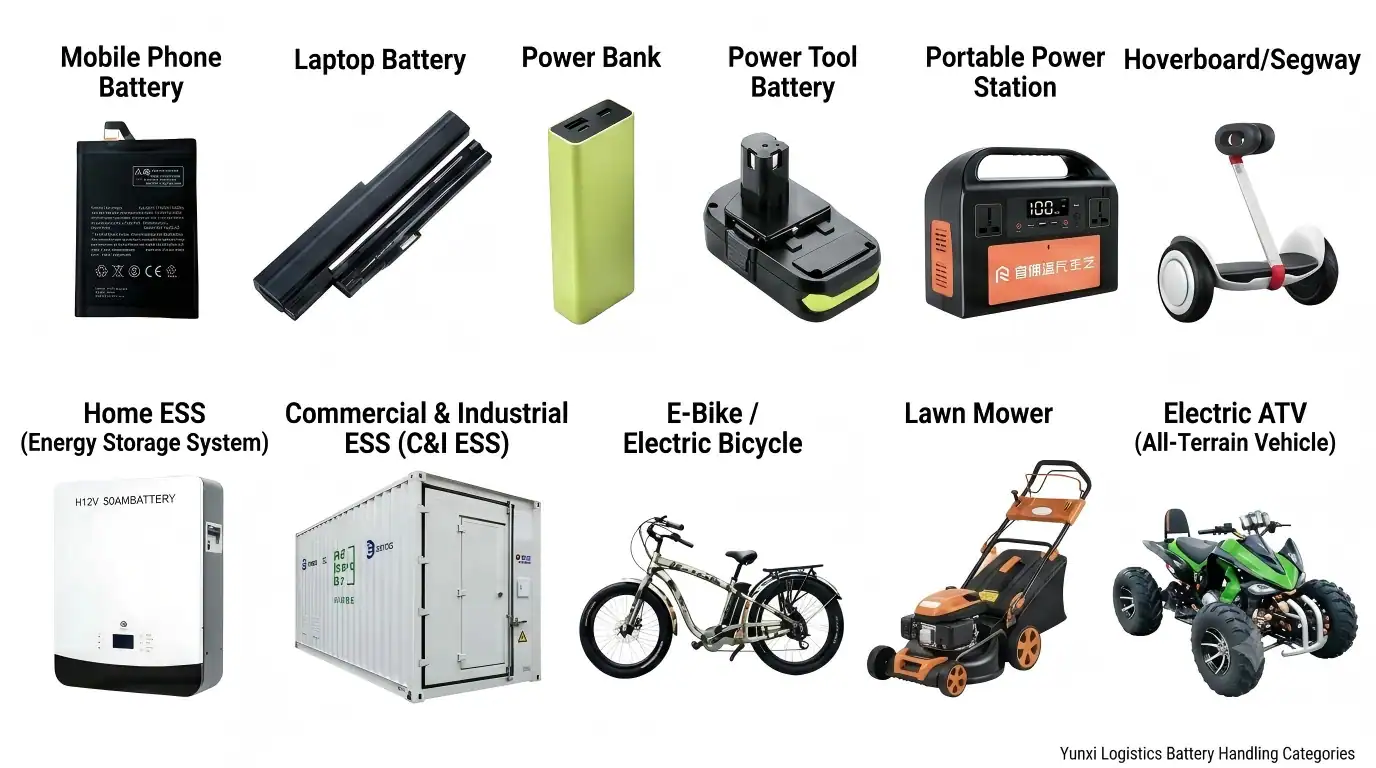
Different battery product categories have unique compliance and handling requirements when shipping lithium batteries via ocean freight:
6.1 Consumer Electronics & Built-In Battery Devices
Products like smartphones, tablets, wireless earbuds, and home appliances with built-in batteries fall under UN3481. They have slightly less strict packaging rules than pure batteries but still require full DG declaration and compliance documentation.
6.2 Power Banks & Portable Chargers
Power banks are classified as UN3480 pure batteries in shipping regulations, even though they are finished consumer products. They require full DG handling and are subject to the same packaging and certification rules as bare battery cells.
6.3 E-Bike & E-Mobility Battery Products
E-bikes, electric scooters, and similar mobility products often use high-capacity batteries that require specialized DG handling. We offer both integrated shipping and battery-separated shipping options to optimize cost and compliance based on your product design.
6.4 Portable Power Stations & Solar Energy Storage
High-capacity energy storage products are among the most heavily regulated battery items. They require DG container shipping and have strict packaging and stowage requirements. We provide specialized solutions for both commercial and residential solar storage products.
7. FAQ: Common Questions About Battery Sea Shipping to the USA
How long does shipping lithium batteries via ocean freight take from China to the USA?
Standard port-to-port transit ranges from 12–18 days for West Coast destinations, with total door-to-door time of 25–35 days including clearance and final delivery. Exact timelines depend on origin, destination, and service type.
Can I ship batteries to Amazon FBA when importing battery products from China?
Yes, as long as the shipment follows all Amazon hazardous goods inbound rules, IMDG regulations, and US import requirements. We provide end-to-end FBA battery shipping services with pre-delivery compliance checks.
How much does sea freight for dangerous goods like lithium batteries cost?
Pricing depends on battery type, cargo volume, weight, destination, and service level. Battery freight costs more than general cargo due to DG surcharges, special handling, and compliance overhead. You can get an exact quote via our free online calculator.
What happens if my battery cargo is seized by US customs?
If detained, the outcome depends on the reason for the hold. Missing documentation can often be resolved by submitting supplementary materials within a set timeframe. More serious violations such as false declaration may result in fines, forced return, or destruction. Our customs team handles issue resolution on your behalf whenever possible.
8. Why Partner With a Specialized Battery Freight Forwarder?
Cross-border battery logistics to the US involves far more complexity than standard freight. Working with an experienced DG logistics provider reduces risk, cuts administrative work, and improves delivery reliability.
8.1 End-to-End Compliance Expertise
Our core team brings 15+ years of dedicated dangerous goods logistics experience, with deep expertise in both Chinese export regulations and US CBP enforcement patterns. We hold official NVOCC certification and customs AEO accreditation, and we conduct a full pre-shipment audit of all documentation, packaging, and product details to keep inspection rates well below industry averages.
8.2 Controlled Full-Stack Operations
Consolidation & warehousing are handled at our own facilities in South and East China, with 30,000+ square meters of domestic warehouse space and 1 million+ square feet of dedicated US overseas warehouse space. This end-to-end control means no subcontracting, clear accountability, and consistent service quality from pickup to final delivery.
8.3 Transparent Pricing & Full Visibility
All our DDP quotes are all-inclusive with no hidden fees. Every shipment comes with real-time tracking via our 17track integration, so you can monitor every milestone from pickup to final delivery. Our 24/7 support team is available to resolve issues and answer questions at any stage of transit.
Whether you are restocking Amazon inventory, importing commercial inventory, or launching a new battery-powered product line, compliant and reliable battery shipping from China to USA is critical to your business success. With specialized DG expertise, fixed weekly LCL sailings, and nationwide US delivery coverage, we help you move your battery cargo safely, on time, and within budget.