LCL Shipping for Oversized Cargo: When to Use FCL or Special Equipment
Blog 2026-11-08
LCL shipping for oversized cargo can work from China to the U.S. if the consolidator accepts each packed piece for the planned route. If your supplier gave you a total cubic volume but one crate is unusually long, heavy, or non-stackable, start with that crate. Find its packed dimensions, gross weight, and forklift entry direction. Then ask whether it can be handled in a shared load. If the answer is no, find out what stopped it. The reason will help you decide whether to check a standard dry container or request an open-top or flat-rack review.
Have a drawing or preliminary measurements for the piece you’re concerned about? You can share them while your supplier is still planning the packaging.
Is LCL Shipping for Oversized Cargo Relevant to Your Shipment?
Pull up your supplier’s packing list. If it shows only total CBM, total weight, and crate count, ask for the packed dimensions and gross weight of each piece. Start with the longest crate and the heaviest crate. They may be different pieces.
Request a piece-by-piece review if a crate is unusually long or heavy, cannot be stacked, must stay upright, or can be lifted from only one side. Flag U.S. delivery constraints separately. The consolidator may be able to handle the crate even if your receiving site lacks the equipment to unload it. Yunxi Logistics can review the packed-piece details and delivery address before quoting.
What to Check Before Requesting LCL Shipping for Oversized Cargo
Start with the row for your longest crate. Repeat the check for the heaviest crate and any piece with different handling restrictions. Mark missing details as pending so your forwarder can tell you what needs to be confirmed before booking.
| Find this in the supplier’s records | What to verify or ask for |
|---|---|
| Packed length × width × height | Confirm these are the maximum outside dimensions, including the skid, handles, and other protrusions. Label the units and mark estimates as estimates. |
| Gross weight per piece | Confirm that the figure includes the product, crate, and skid. If the list gives only the shipment’s total weight, request the weight of each piece. |
| Photo or drawing of the crate base | Mark the fork openings and entry direction. If a planned lift is needed, provide the center of gravity and designated lifting points when available. |
| Stacking and orientation instructions | Ask whether other freight can sit on top, what load the crate can support, and whether it must remain upright. |
DHL Global Forwarding’s LCL packaging guide explains why forklift access and stackability matter in a shared load. Use the proposed consolidator’s requirements to confirm acceptance for your route. For crate construction and pallet preparation, see the oversized cargo packaging guide.
Which Option Should You Check Next?
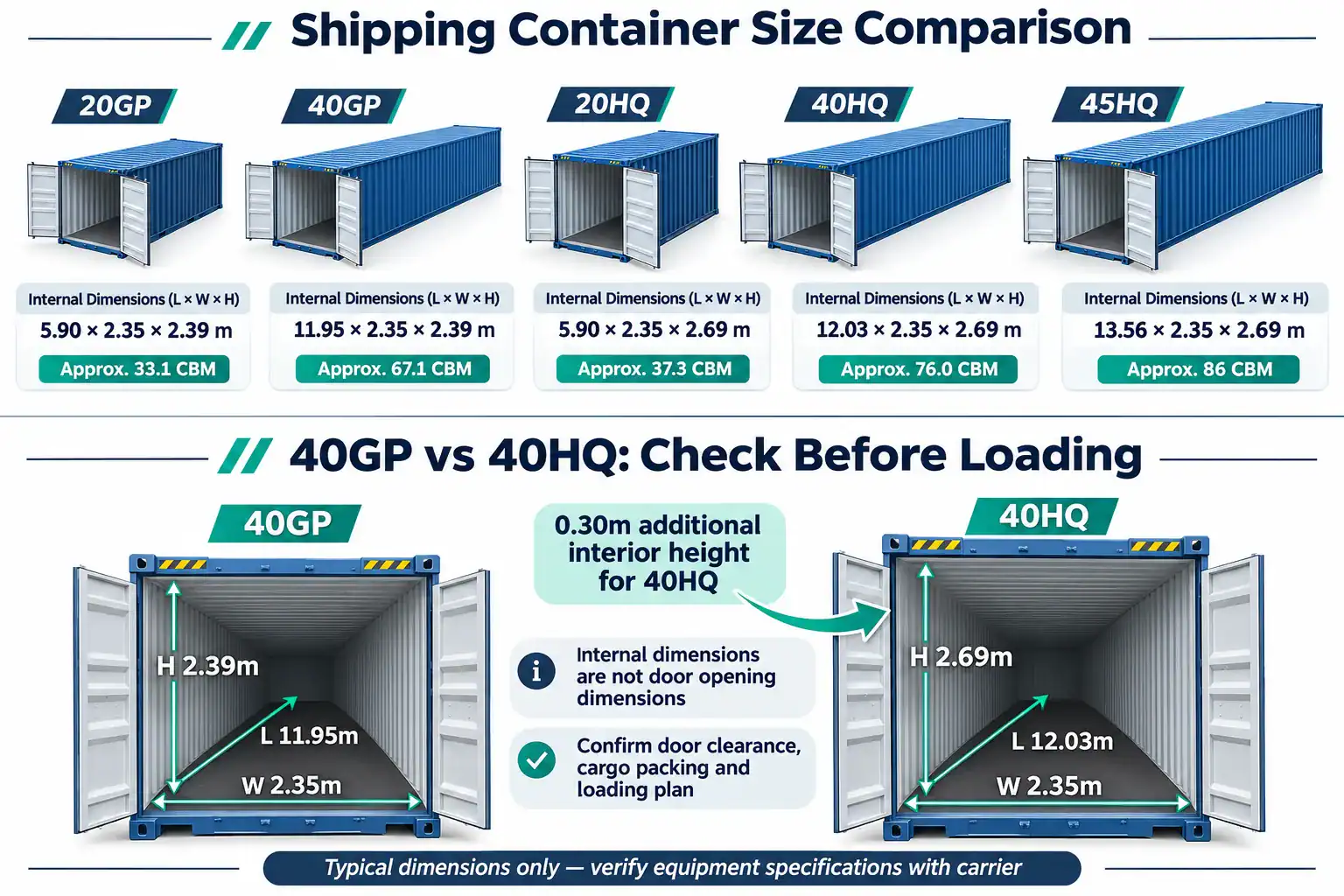
If your consolidator cannot accept the crate, use the chart below to compare typical dry-container interior dimensions. Then ask your forwarder to confirm the actual door opening and whether the crate can be maneuvered, secured, and unloaded with the equipment available at both ends.
| Container | Internal dimensions (L × W × H) | Approximate volume |
|---|---|---|
| 20GP | 5.90 × 2.35 × 2.39 m | 33.1 CBM |
| 40GP | 11.95 × 2.35 × 2.39 m | 67.1 CBM |
| 20HQ | 5.90 × 2.35 × 2.69 m | 37.3 CBM |
| 40HQ | 12.03 × 2.35 × 2.69 m | 76.0 CBM |
| 45HQ | 13.56 × 2.35 × 2.69 m | 86 CBM |
40GP vs 40HQ: Check Before Loading
The chart shows 0.30 m additional interior height for 40HQ. Internal dimensions are not door opening dimensions. Confirm door clearance, cargo packing and loading plan. Verify equipment specifications with the carrier.
An open-top container may suit cargo that needs to be lifted in from above. A flat rack may suit cargo that requires side loading or extends beyond enclosed equipment. Maersk classifies special cargo according to how the loaded piece fits the applicable equipment limits. A piece can require special equipment and still be in gauge. Ask the carrier to confirm the classification for your planned load.
Example: What Would Rule Out LCL for a 2.43 CBM Crate?
Assume a non-stackable machine crate measures 3.8 × 0.8 × 0.8 m and weighs 1,200 kg packed. Multiplying its packed dimensions gives 2.432 m³, or about 2.43 CBM. The buyer requests LCL shipping for oversized cargo, but the origin warehouse confirms it cannot safely turn the crate in its loading area. That rules out LCL on the proposed route. The next question is whether the forwarder and loading team can load the crate straight into a standard dry container, support and secure it, and unload it safely at destination. If they confirm those checks, request a standard FCL quote. If the loading path or handling plan fails, send the same drawing for an open-top or flat-rack review. Maersk’s Special Cargo guidance, checked , explains how loaded dimensions relate to the proposed equipment and cargo classification.
Customer Inquiry: When a Full Container No Longer Fits Every Order
In , an office furniture brand began planning a shipment from its supplier in Huzhou, Zhejiang. The brand had been booking full containers to port, but its order volumes varied throughout the year. The customer reported paying for unused container space more than 20 times a year. The question was which smaller orders could move separately without waiting for enough cargo to fill a container.
In October, Yunxi’s oversized freight team reviewed the customer’s shipping needs and proposed oversized LCL with DDP delivery for smaller batches that pass piece-by-piece review. The proposed door-to-door scope brought ocean freight, import clearance, applicable duties and taxes, and delivery into one quote. The customer could assess smaller batches individually and still consider FCL for larger orders. Each batch would still need its packed dimensions, gross weight, route acceptance, and handoff and unloading arrangements confirmed.
Try the same check on your orders. Pull a recent FCL quote and the packing list for a smaller batch. Flag the longest and heaviest pieces, then ask whether they qualify for LCL on your route. If both modes are feasible, use the FCL vs. LCL cost comparison to compare costs through the same U.S. delivery point. Include any services you would arrange separately under the port-to-port quote.
If you have a packing list but still need some measurements, share what you have and flag the pieces that need a closer look.
How to Compare Two Quotes for the Same Crate
Put the two quotes side by side. Check that they use the same packed dimensions, gross weight, pickup address, U.S. ZIP code, and delivery handoff point. If you’re comparing LCL shipping for oversized cargo with FCL, mark each service as included, excluded, or to be confirmed. Check China pickup, origin handling, ocean freight, destination handling, customs, U.S. delivery, and unloading. For a DDP quote, confirm which duties and taxes are included and what information the forwarder needs to confirm the customs arrangements.
Find the final delivery line on your quote. Does it say where the carrier hands over the crate and who provides and operates the unloading equipment? If it says only “door-to-door,” ask the forwarder to put the handoff point and unloading responsibility in writing before you compare totals.
With dedicated oversized cargo shipping, Yunxi can review pickup, handling, and delivery together. If you’re considering liftgate delivery, provide the packed dimensions and gross weight so the carrier can check platform fit and capacity.
Quote Checklist for LCL Shipping for Oversized Cargo
- Product, crate count, and packed dimensions and gross weight per piece
- Crate photos, forklift entry direction, and stacking or orientation restrictions
- China pickup city and cargo-ready date
- U.S. ZIP code, address type, vehicle access, and requested handoff point
- Unloading equipment on site and who will operate or arrange it
Frequently Asked Questions
Are there standard size and weight limits for LCL shipping for oversized cargo?
Ask the consolidator for its single-piece limits on the proposed route. Provide the packed dimensions and gross weight so it can also check equipment capacity, stacking restrictions, and handling at the destination facility.
Can a non-stackable crate still travel in a shared container?
Yes, if the consolidator accepts it and can reserve the space it needs. Ask whether leaving the space above the crate clear affects the quote.
Can I get an estimate before the supplier finishes packing?
Yes. Mark estimated dimensions and weights clearly, and ask which changes could affect equipment or price. Submit the final packed measurements for confirmation before booking.
What if my U.S. delivery site has no dock or forklift?
Tell the forwarder before it quotes. Share the packed measurements, site access, and requested handoff point so it can check whether suitable unloading equipment can be arranged and who will provide it.
About the Author
The Yunxi Logistics Operations Team has hands-on experience coordinating oversized freight from China to the United States. The team reviews packed dimensions, piece weights, and handling requirements to help importers assess LCL and FCL options, prepare cargo for shipment, and plan the U.S. delivery handoff.
Send the Crate Details You Have
If you’re considering LCL shipping for oversized cargo, start with your longest and heaviest pieces. Use the quote form when your shipment details are ready and you want to compare feasible options. If you have a drawing or photos and want an initial review, email them with your U.S. delivery ZIP code.
Sources and Further Reading
Official and Primary Sources
- DHL Global Forwarding — Ocean Freight LCL Packaging Guidelines. Explains stackability and forklift handling for consolidated cargo.
- Maersk — Special Cargo. Explains open-top and flat-rack options, in-gauge and out-of-gauge classification, and equipment-specific limits.
- Maersk — Special Cargo Terms: In-Gauge Cargo. Describes equipment limits, cargo information, and booking confirmation.